AI Resume Screening: How to Rank Hundreds of Resumes in Seconds
What is AI resume screening, how does it work, and what are the benefits? Learn why an explainable fit score changes everything and what to look for.
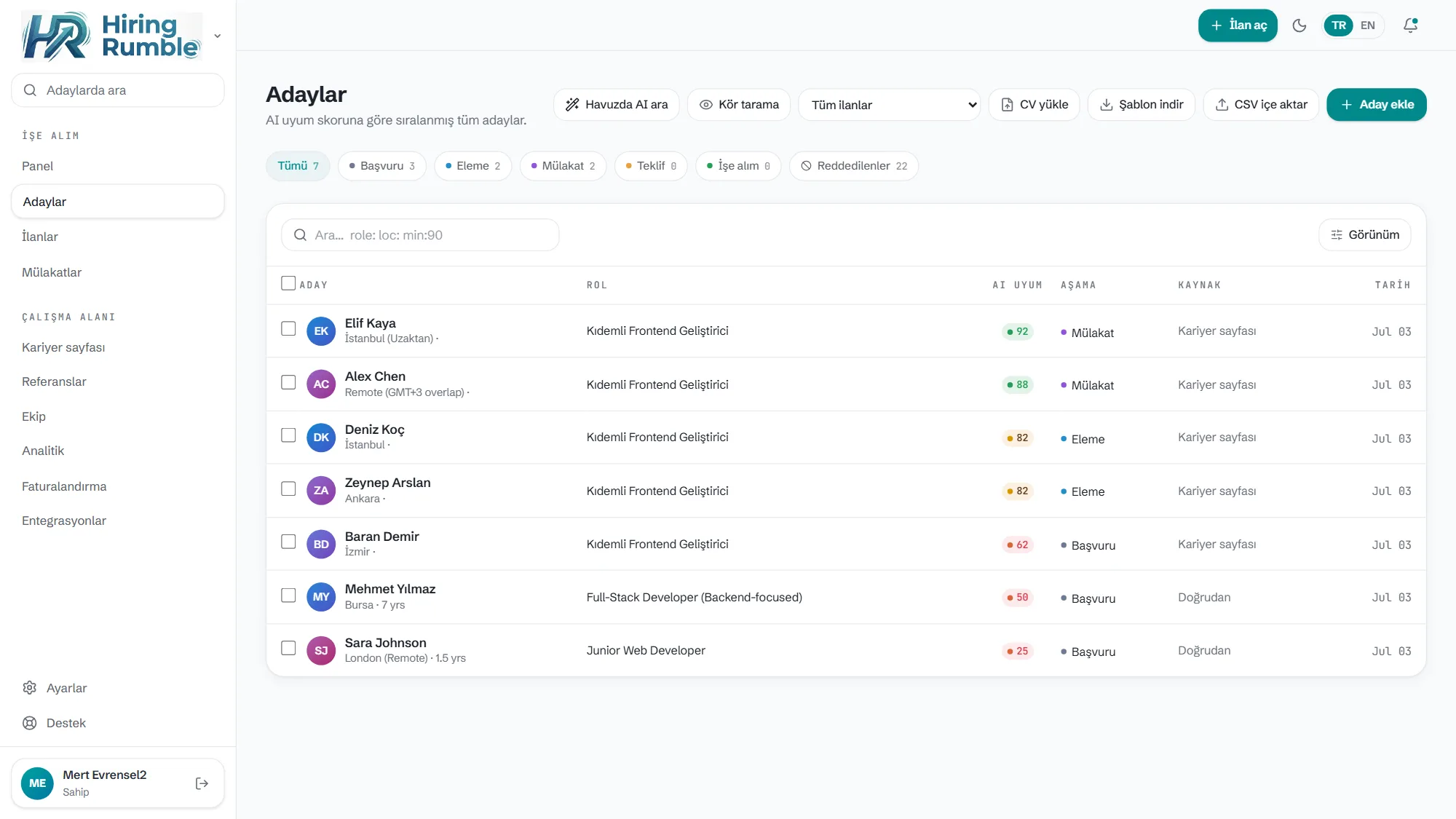
Every open role brings 200 resumes, and you have to read them alone. AI resume screening exists to clear exactly this bottleneck: it reads each resume against your job's requirements, gives it a fit score from 0 to 100, and floats your strongest candidates to the top. But the one thing that separates a good system from a bad one isn't speed — it's being able to see why a candidate scored the way they did. This guide walks through what AI resume screening is, how it works, its benefits, and what to look for when you choose one.
What is AI resume screening?
AI resume screening means that instead of reading every incoming resume by hand, an AI engine compares each one against your role's requirements and assigns a fit score. The goal isn't to reject candidates for you; it's to rank the pile, surface the most promising profiles, and take the exhausting first pass off your plate.
In traditional screening, a recruiter skims hundreds of resumes, hunts for a few keywords, gets tired, and grows inconsistent. A resume read at 9 a.m. isn't judged the same as one read at midnight. Automated resume review removes that inconsistency: every candidate is scored against the same criteria, with the same attention.
How does AI resume screening work?
A well-built candidate screening software follows these steps:
1. It builds job context
The engine first understands what your role needs: which skills are required, what experience level you're after, the true requirements of the job. In Hiring Rumble you either write the posting yourself or generate it with AI; scoring is done against that context.
2. It parses the resume
Every resume that arrives as a PDF or DOCX is automatically turned into structured data — skills, work history, education, years of experience. Manual data entry disappears.
3. It produces a fit score
The engine gives each resume a fit score from 0 to 100. In Hiring Rumble this runs in two modes:
- Score (fast screening): an automatic, fast score on every application — instant ranking for small teams.
- Deep Match: a deeper, reasoned evaluation powered by Claude Sonnet — human-like, nuanced analysis for critical roles.
4. It explains the reason
This is the critical difference. Alongside the score comes a reasoned breakdown of why it gave that score — across skills, experience, and fit. This is the heart of the product: a "not a black box" approach.
5. It leaves the decision to you
AI screens and ranks; you make the final call. The system never auto-rejects anyone for you.
The benefits of AI resume screening
It gives you your time back. Instead of hundreds of resumes to read by hand, your strongest candidates surface at the top in seconds. Screening night is over.
It brings consistency. Every candidate is scored against the same criteria; the morning-vs-midnight, first-vs-last-resume gap disappears.
You can defend your decisions. Because you see the reason behind the score, you have a concrete answer to "why did you shortlist this candidate?" You stay consistent with your team and your hiring manager.
It closes your expertise gap. You may not always have the expertise to judge a technical role; a reasoned score shows how well each skill overlaps and points you in the right direction.
Good candidates don't slip through. A strong profile buried at the bottom of the pile rises to the top thanks to the fit score.
Why is an explainable score so important?
Many tools on the market give you a score but not the reason. That's a problem, because:
- Blind-trust risk. Hiring a candidate when you don't know why they scored high is blind surrender to the AI.
- Hidden bias. If a black-box model behaves with bias, you can't spot it. Transparency is the first condition for reducing bias.
- No accountability. Hiring decisions carry legal and ethical responsibility. "The system said so" is not a defense.
An explainable fit score flips all of this: every score has a reason, and you make and defend the decision. That's why Hiring Rumble makes "AI screens, you decide" the anchor of its message.
What to look for when choosing AI resume screening
- Explainability. Does it show the reason behind the score, or just a number? No reasoning, no thanks.
- Decision control. Does the system auto-reject candidates, or leave the call to you? The decision should stay with the human.
- Easy import. Can it take your existing resumes (PDF/DOCX) and CSV easily?
- Price and transparency. Is it affordable for a small team? Is the AI cost predictable? In Hiring Rumble, AI usage is shown clearly in credits — no surprise bill.
- Try before you buy. Can you try it without setup? You can see Hiring Rumble instantly in keyless demo mode with sample candidates.
- Language support. Can you communicate with Turkish and global candidates in their own language? Hiring Rumble is bilingual (TR/EN) across the interface and candidate emails.
Where to start
Moving to candidate screening software doesn't have to be a big project. In Hiring Rumble's keyless demo mode you can see the system with realistic sample candidates without setting anything up; then open a role of your own and drag in your first resumes to build a scored pipeline in minutes. AI surfaces your strongest candidates, with reasons — you make the decision. See the pricing page for plans.
Frequently Asked Questions
How does the AI fit score work? Hiring Rumble reads each resume against your job's requirements; it scores from 0 to 100 across skills, experience, and fit, and provides a reasoned breakdown of why it gave that score for each criterion — not a black box. The decision always stays with you.
Won't AI ruin hiring or introduce bias? Hiring Rumble doesn't make the decision for you. It shows the reason behind the score, and you approve or reject. Transparency is how you reduce bias — an explainable score, not a black box.
Do I need an API key to try it? No. It opens in demo mode with realistic sample candidates and roles; you can click around right away.