How to Build a Hiring Funnel (A Stage-by-Stage Guide)
What is a hiring funnel and how do you build one? Learn the stages from application to hire, each stage's purpose, and how to manage the pipeline in one place.
If you treat hiring as "look at incoming applications and decide," you'll get lost when volume grows. An organized hiring funnel moves candidates through clear stages from application to hire; you see at a glance where each candidate is, where the process narrows, and what the next action is. This post explains what a hiring funnel is, its stages, and how to build one practically — then how to manage it in a single pipeline.
What is a hiring funnel?
A hiring funnel (or pipeline) is the set of sequential stages candidates pass through in the hiring process. It's called a "funnel" because the number of candidates shrinks at each stage: it starts with many applications and ends with a single hire. Making the funnel visible makes your process manageable and measurable.
Standard stages
A solid foundation for most teams is:
- Applied — candidates arrive from the careers page or via import.
- Screening — resumes are evaluated against the role; the best fits surface.
- Interview — you meet the shortlist.
- Offer — an offer is made to the chosen candidate.
- Hired — the offer is accepted and the process closes.
You can use this default flow or add stages to fit your work (e.g., "Phone screen," "Technical assessment," "Reference check").
Build the funnel step by step
1. Define the stages
Put your hiring process on paper: which steps exist, and what's each step's purpose? Unnecessary stages slow the process; missing stages create blind spots.
2. Set entry/exit criteria for each stage
What does a candidate need to move to the next stage? When criteria are clear, transitions become consistent and defensible.
3. Add scorecards and reasoning
Standardize what you evaluate candidates on at each stage. Scorecards enable a consistent, traceable evaluation across the team.
4. Connect automation
When a stage changes: an update to the candidate, a task to the team — automate the repetitive work. So the funnel flows on its own and you focus on bottlenecks.
5. Measure and improve
Look at the conversion rate at each stage. Wherever it narrows (for example, a low interview-to-offer rate), examine and fix it.
Managing the funnel in a single pipeline
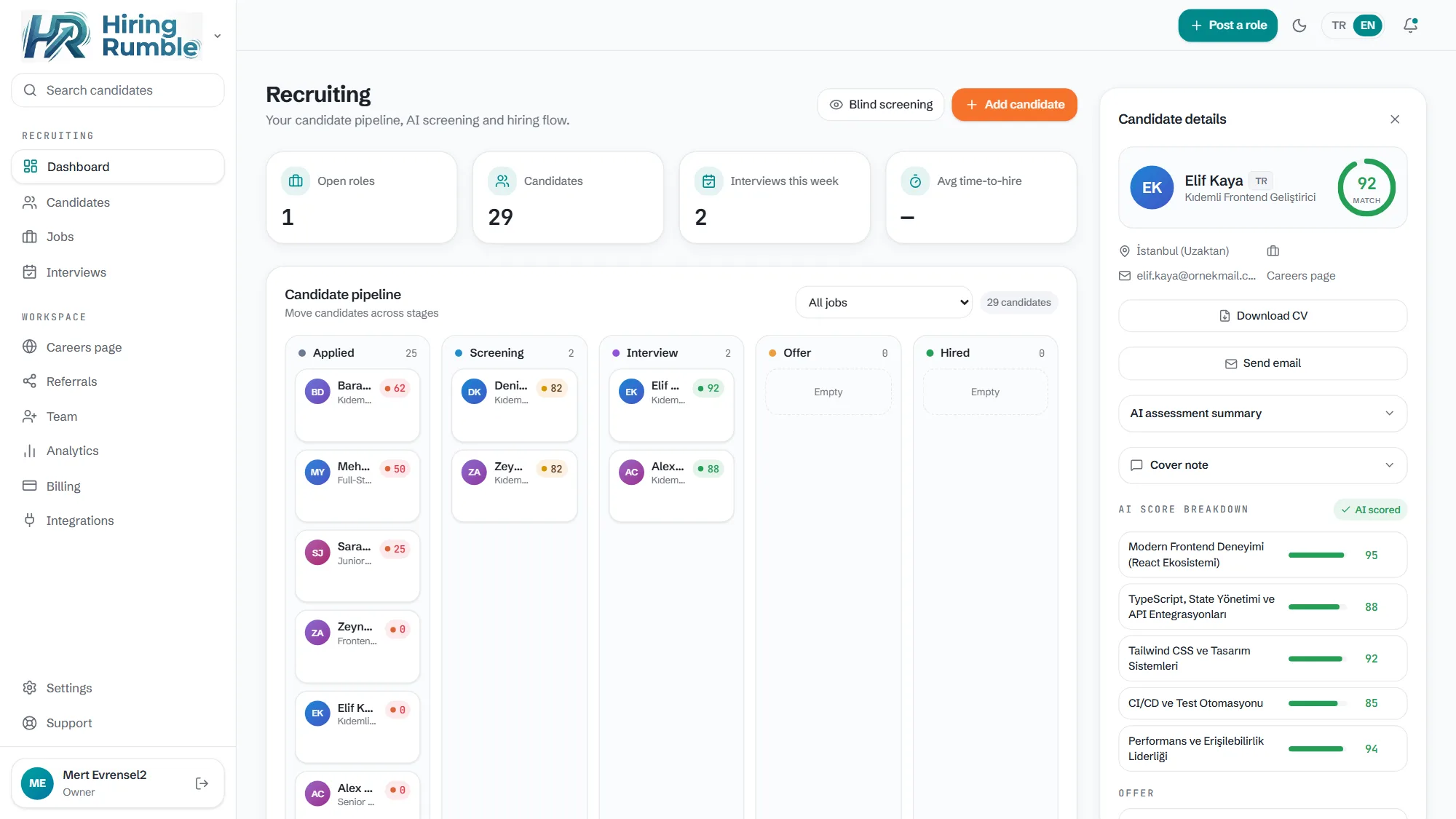
Scattered emails and spreadsheets make the funnel invisible. Hiring Rumble brings the whole process into a single pipeline kanban: you drag candidates between stages and see where each one is at a glance. Applications arrive automatically from the careers page, and AI reads each resume against the role, dropping it into the screening stage with a 0-100 fit score and the reason for every score. You use the default Applied → Screening → Interview → Offer → Hired flow or add your own stages; scorecards and automation are defined per stage. When a stage changes, an automatic email goes to the candidate in their own language, and funnel conversion shows up in analytics.
In short: build the funnel, let AI speed up the first pass, and focus on the bottlenecks and the decision.
Related reading: Recruitment Metrics · Reduce Time to Hire