Why Is Employee Referral Hiring Still the Highest-Quality Channel?
Why is employee referral hiring the highest-quality channel? The benefits of a referral program, how to build one, and how to evaluate referrals consistently.
Among all the job boards, social networks, and AI-powered sourcing tools, the highest-quality candidate often comes from the oldest method: employee referral hiring. Candidates your employees know and recommend usually fit better, move faster through the process, and stay longer — because they arrive over a bridge of trust. This post explains why referrals are still the strongest channel, how to build a systematic referral program, and how to evaluate incoming referrals fairly and consistently.
Why are referrals so powerful?
- Pre-filtered quality: a candidate recommended by an employee putting their own reputation on the line has already crossed a trust threshold.
- Better cultural fit: someone who knows the team from the inside can better judge whether a candidate will fit.
- Faster process: referred candidates are usually more engaged and respond faster.
- Lower cost: you reach qualified candidates without posting and sourcing costs.
How to build a systematic referral program
1. Make asking easy
Keep it simple for employees to refer: make it clear who and how to recommend. The less friction, the more referrals come in.
2. Share what kind of candidate you need
Share open roles and the profile you're looking for clearly with your team. People can't recommend the right person without knowing what you're after.
3. Make referrals visible
Tag where incoming referrals come from and track them through the process. Seeing which channel (including referrals) brings quality candidates tells you where to put effort.
4. Give feedback
Let the referring employee know how the process is going. Tossing a recommendation into a closed box discourages people from referring again.
5. Evaluate referrals fairly too
A referral is an advantage, not an automatic pass. Evaluate referred candidates by the same criteria as others; that preserves both fairness and quality.
Managing referrals in Hiring Rumble
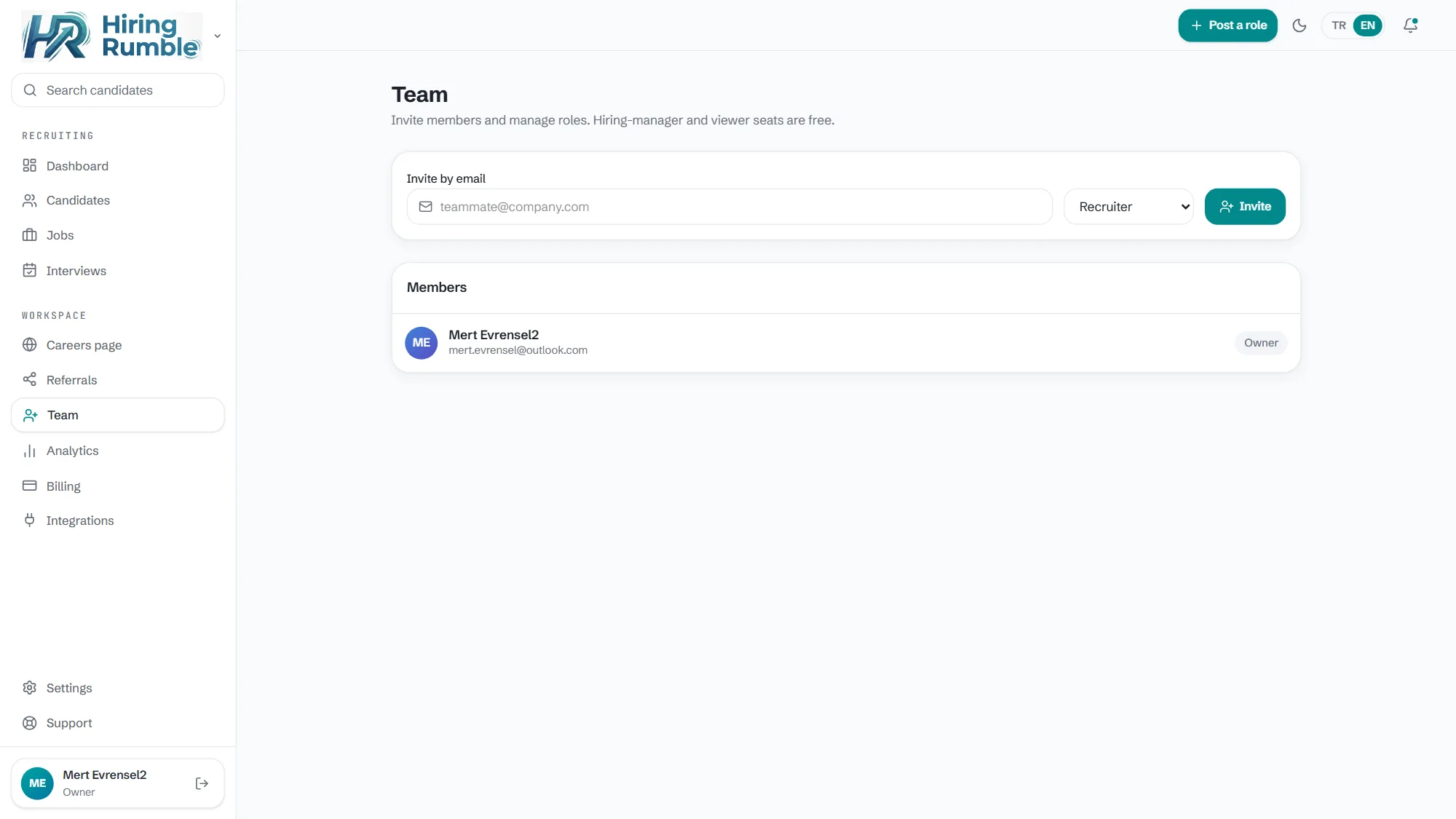
Even though referrals are the highest-quality channel, incoming candidates still need to be evaluated consistently — and it's important not to fall into channel blindness. With Hiring Rumble's referral program flow, you systematize employee referrals; these candidates enter the pipeline like everyone else. Because AI reads each resume against the role and gives a 0-100 fit score with the reason for every score, a referred candidate is evaluated by the same transparent measure. With quality-per-source analytics, you see with data whether referrals are truly your best channel.
In short: use your highest-quality channel systematically, but evaluate every candidate — referred or not — by the same reasoned measure. The decision is always yours.
Related reading: Create a Careers Page · AI Resume Screening
Frequently Asked Questions
Should referred candidates pass automatically? No. A referral is a strong signal but not a guarantee. Evaluating referred candidates by the same criteria preserves both fairness and quality.
How do I know referrals actually work? Look at the quality-per-source metric: compare the conversion and quality of candidates from the referral channel against other channels.
Does Hiring Rumble support a referral flow? Yes, there's an employee referral flow; referred candidates are also parsed automatically and enter the pipeline with a reasoned score.