
High-Volume Hiring: How Do You Manage 200 Applications?
How do you manage high-volume hiring? Practical ways to evaluate 200 applications for one role fairly and fast without drowning — and the role of AI.
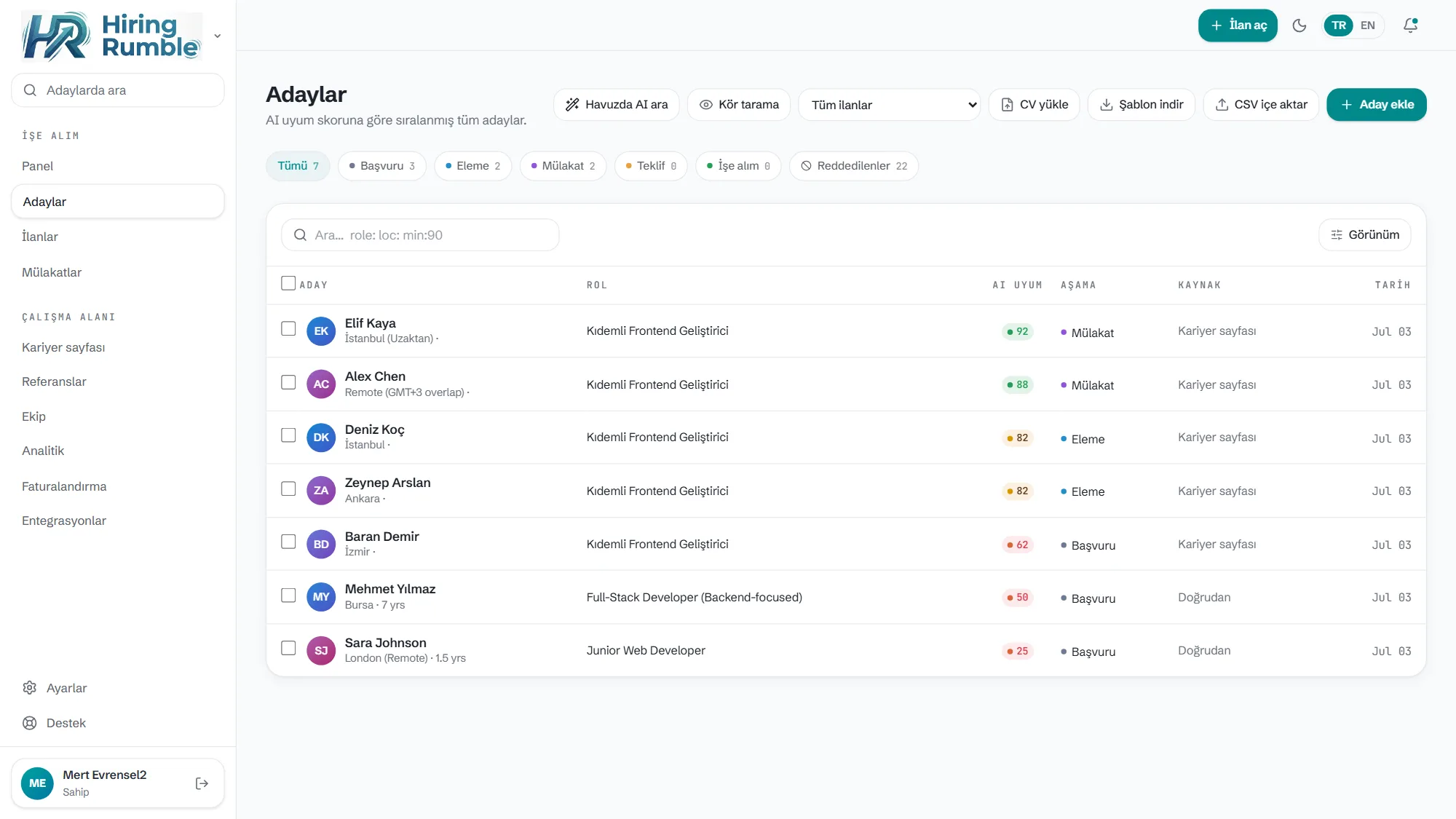
You opened a single posting for a popular role and within a few days 200 applications arrived. That's a good problem — but unmanaged, it quickly turns into a nightmare. High-volume hiring is being able to move forward without drowning in the incoming pile, treating every candidate fairly, and not missing the good ones. This post explains why high application volume is challenging, the practical ways to manage it, and how AI makes 200 applications evaluable in minutes — while keeping the decision yours.
Why is high volume challenging?
- Time: reading 200 resumes by hand takes hours, even days — and in that time the best candidate accepts another offer.
- Inconsistency: fatigue makes you measure the first and last resume differently; fairness suffers.
- Missed candidates: a strong candidate overlooked in the pile is a permanent loss.
- Candidate experience: a slow process means hundreds of candidates left in silence; your brand takes a hit.
Practical ways to manage high volume
1. Clarify criteria first
Before screening, write down required and preferred criteria. As volume grows, the value of clear criteria multiplies.
2. Standardize and speed up the first pass
On the first round, look only at the "must haves"; apply the same measure to everyone. The goal is to narrow the shortlist quickly.
3. Remove repetitive work with automation
Automate repetitive communication like application acknowledgments, stage updates, and rejection messages; save your energy for evaluation.
4. Focus on the shortlist with human eyes
Let AI narrow the volume, but always read the shortlist yourself. Nuance and context need human judgment.
5. Be fast
At high volume, speed is the key to not losing the best candidate. Clear stages and an automatic flow speed up the process.
Turning 200 applications into minutes
In manual screening, a pile of 200 resumes slows down even the most organized team. This is exactly where AI steps in: Hiring Rumble reads each resume against the role, ranks them in seconds with a 0-100 fit score, and shows the reason for every score across skills, experience, and fit. So a pile of 200 applications becomes a reasoned shortlist with the strongest candidates surfacing at the top. For critical roles, Deep Match (Sonnet) offers a more nuanced analysis.
High volume also stays predictable thanks to the credit model: you see AI usage clearly via credits, no surprise bill; quotas on higher plans are generous for high-volume teams. And most important: AI ranks and gives reasoning, but you make the accept or reject. AI narrows the pile; the human makes the decision.
Related reading: AI Resume Screening · Reduce Time to Hire