AI in Recruitment: A Practical, Balanced Guide for 2026
Where does AI in recruitment help, and where should humans stay? Practical starting steps and a reassuring "AI screens, humans decide" balance.
AI is changing recruitment fast, but the noise around it splits most teams in two: on one side the "AI will solve everything" hype, on the other the "AI ruins hiring" fear. The truth sits between them. AI in recruitment, used in the right place, is a powerful assistant that gives you your time back; used in the wrong place, it's a risky black box. This guide lays out where AI helps in recruitment, where the human should stay, and where to start — in a balanced, reassuring frame.
Where does AI help in recruitment?
Resume screening
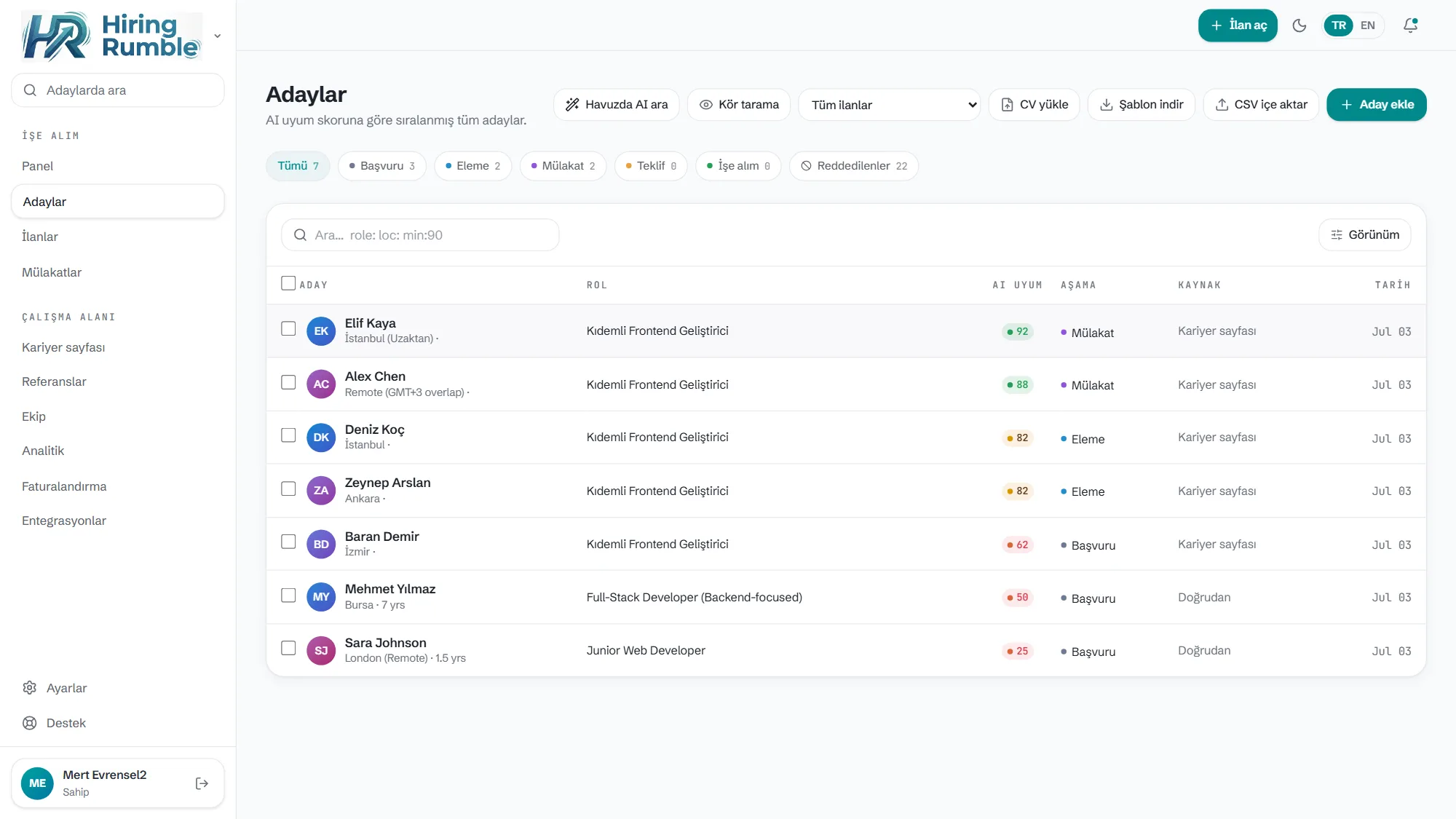
The clearest win. AI reads hundreds of incoming resumes against the role and ranks them in seconds. The first pass — where humans get tired and inconsistent — is where AI is strongest. Hiring Rumble gives every application a 0-100 fit score and shows the reason.
Resume parsing
Turning skills, experience, and education from PDF/DOCX into structured data — it removes manual data entry entirely.
Writing job postings
It solves the blank-page problem; from a few inputs it produces a professional posting draft (which you edit).
Re-evaluating the candidate pool
Re-scanning past candidates against a new role (re-search) extracts value from the pool you already own.
Routine communication
Automatic emails to the candidate in their own language as stages change — it professionalizes the candidate experience so no one is left hanging.
Where should AI NOT stay in recruitment? (The human's domain)
- The final decision. Accept or reject must always stay with the human. AI screens and recommends; it doesn't decide.
- Context and judgment. The nuance in a candidate's story, cultural fit, motivation — these need human judgment.
- Relationship. Interviews, persuasion, offer conversations are human processes.
- Ethical oversight. Questioning the AI's recommendation and spotting bias is the human's responsibility — which is why explainability is essential.
The anchor is clear: AI screens, humans decide.
Practical starting steps
- Start with a single role. Not the whole process — pick the position that gets the most applications.
- Choose an explainable tool. Never trust an AI that doesn't show the reason behind the score.
- Keep the decision human. Use AI for ranking and pre-screening; make the accept/reject yourself.
- Preserve transparency. Keep credit/cost and score reasoning visible.
- Measure. Check whether time-to-hire and the funnel actually improve.
- Try risk-free. Start in keyless demo mode without setting anything up.
Hiring Rumble's approach
Hiring Rumble is built on this balance: AI reads each resume against the role, gives a 0-100 fit score, and explains every score with reasoning across skills, experience, and fit (Deep Match with Claude Sonnet for critical roles). No candidate is auto-rejected; AI uses only your context; AI cost is transparent via credits. In short: enterprise-ATS smarts at a small-team price — and the decision is always yours.
Related reading: Explainable AI Hiring · AI Resume Screening
Frequently Asked Questions
Won't AI in recruitment create bias? A black-box AI can; an explainable AI, on the contrary, helps reduce bias. Hiring Rumble shows the reason behind every score, so you can spot and correct an illogical pattern. The decision always stays with you.
Will AI hire for me? No. AI screens, ranks, and offers a recommendation; you make the accept or reject. It doesn't replace the human — it makes the work easier.
Do I need a technical team or an API key to try it? No. Hiring Rumble opens instantly in keyless demo mode with realistic sample candidates; no technical team required.