Explainable AI Hiring: Why You Shouldn't Trust a Black Box
How does explainable AI hiring solve the risks of black-box AI? The role of transparency in reducing bias and the "human keeps the decision" principle.
AI is speeding up hiring — that's no longer in dispute. But one question follows it like a shadow: when AI surfaces a candidate, do you know why it surfaced them? If your answer is "no, it just gives a score," then you're trusting a black box. Explainable AI hiring exists precisely to solve this problem. This post looks at the risks of black-box AI, why an explainable score makes a difference, and the role of transparency in reducing bias.
The three risks of black-box AI
1. Blind trust
If you don't know why a candidate scored high, you've handed your decision blindly to an algorithm. A good recruiter should be able to ask "why"; a black box leaves that question unanswered.
2. Hidden bias
If a model behaves with bias and gives you only a number, you have no chance of catching it. When bias is invisible, it can't be corrected. AI bias in hiring is a serious ethical and legal risk.
3. No accountability
Hiring decisions carry responsibility. When you have to explain why a candidate didn't move forward, "the system said so" is not a defense. Without transparency, you can't be accountable.
What does an explainable score change?
An explainable AI shows, alongside a score, why it gave that score: which skills overlapped, how well the experience fit, where it fell short. This strengthens the decision in three ways:
- It restores trust: you look at the reasoning, not just the number.
- It makes bias visible: with the reasoning in the open, you can spot and correct an illogical pattern. Transparency is the first condition for reducing bias.
- It makes your decision defensible: within your team and legally, a concrete rationale stands behind your call.
The "human keeps the decision" principle
The natural consequence of explainability is this: AI screens, ranks, and offers a recommendation — but a human makes the accept or reject. No system that puts AI in the human's place is safe. The right setup uses AI as an assistant and leaves the final judgment to you. Hiring Rumble makes this principle its anchor: "AI screens, you decide."
How Hiring Rumble applies this
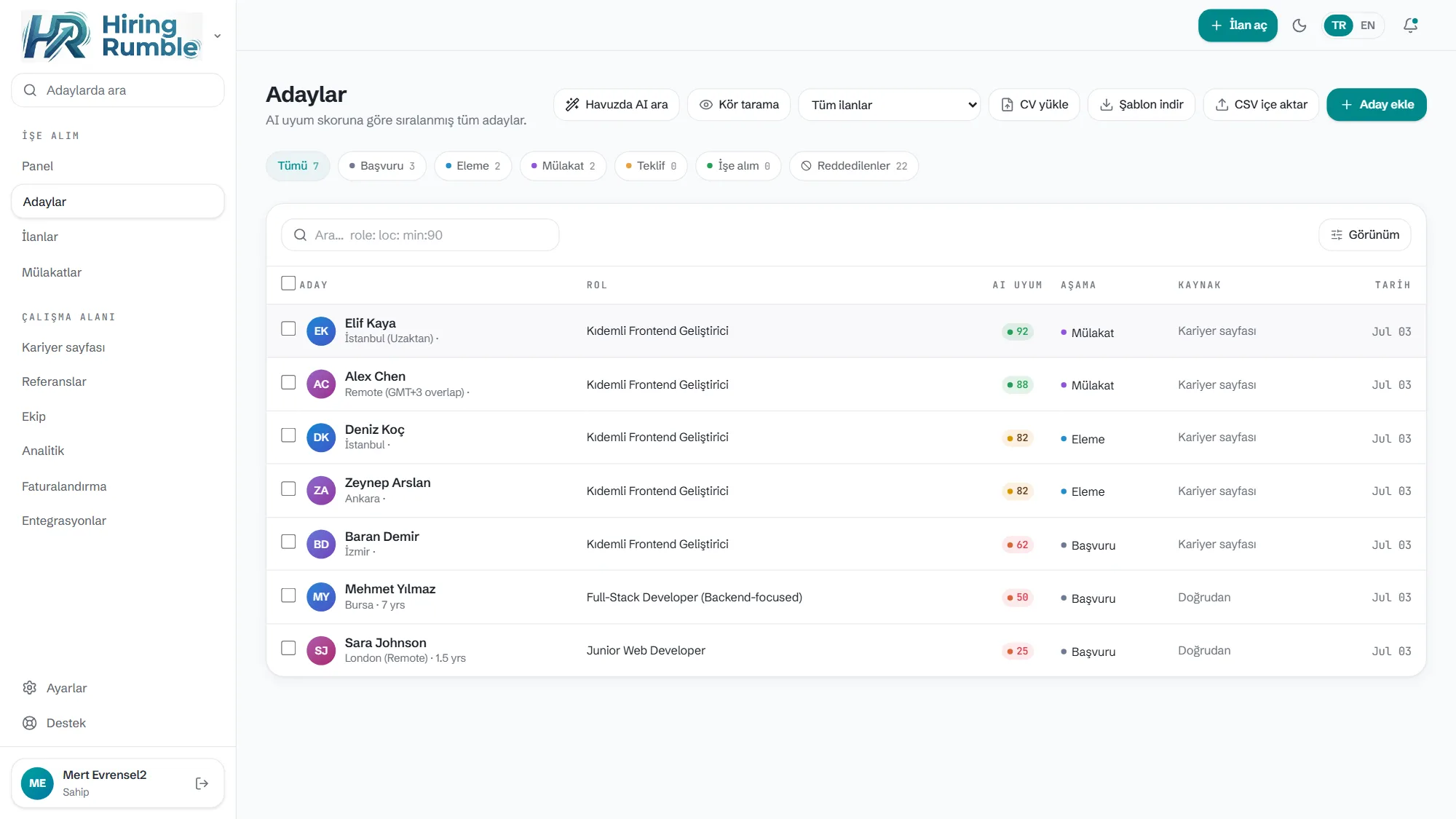
Hiring Rumble reads each resume against the role, gives a 0-100 fit score, and explains every score with a reasoned breakdown across skills, experience, and fit. For critical roles, Deep Match (Claude Sonnet) offers a more nuanced analysis. No candidate is auto-rejected; the system uses only your job and resume context. In short: not a black box, but an explainable score — and the decision is always yours.
Related reading: AI Resume Screening · AI in Recruitment