
Candidate Evaluation Criteria: How to Build a Fair, Consistent Rubric
How do you set candidate evaluation criteria? How to build a consistent rubric across skills, experience, and fit — and balance AI with human judgment.
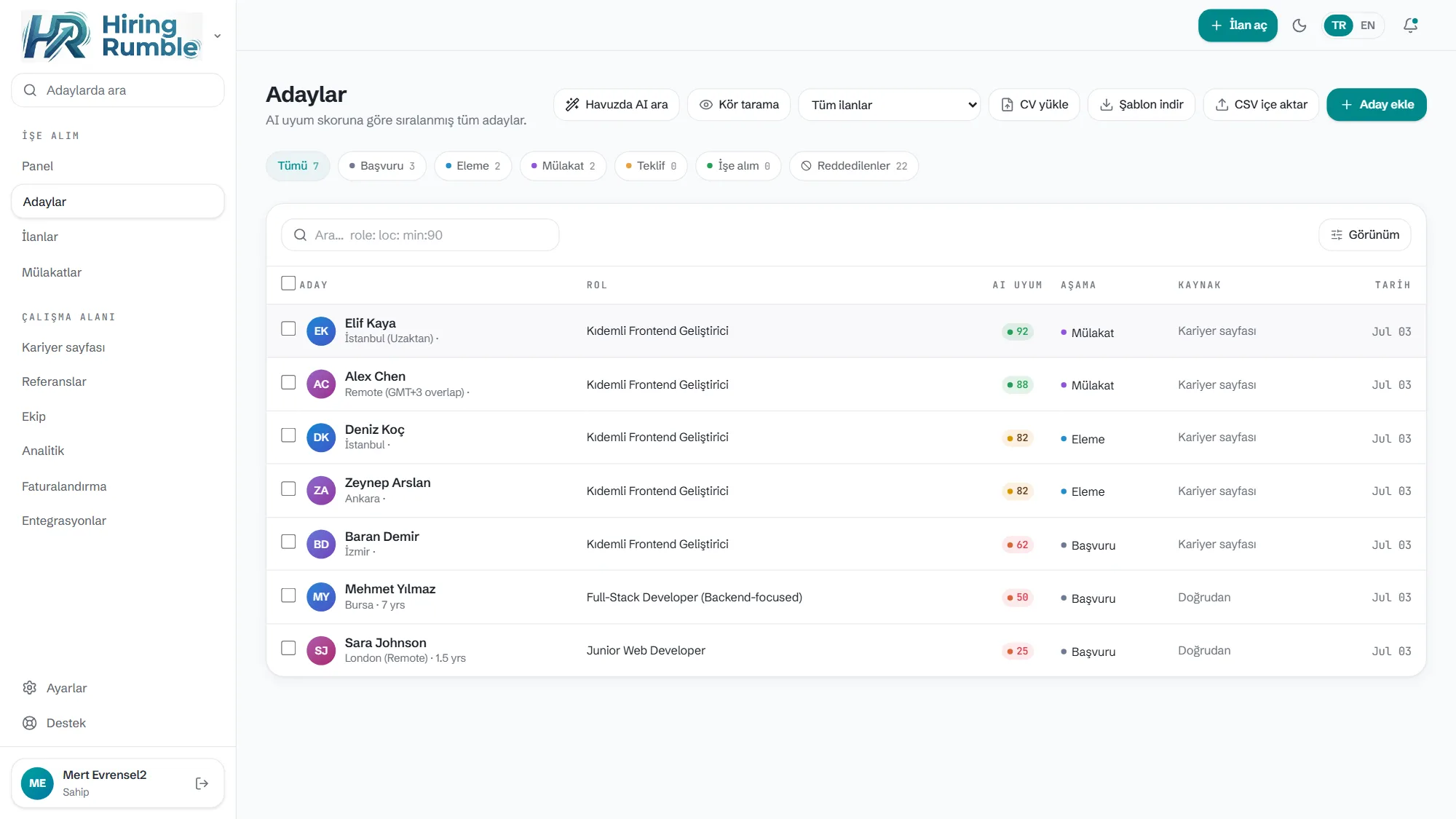
If two recruiters look at the same candidate and reach different decisions, the problem isn't the candidate — it's the vagueness of the criteria. Selection made without clear candidate evaluation criteria stays open to personal sympathy, first impressions, and hidden bias. A well-built evaluation rubric, on the other hand, weighs every candidate by the same measure, grounds your decision in evidence, and makes it defensible. This post covers how to build a strong evaluation rubric, which dimensions to look at, and how to balance AI with human judgment.
Why do you need a good evaluation rubric?
- Consistency: every candidate is scored on the same dimensions; the morning-vs-night, first-vs-last candidate gap disappears.
- Fairness: evaluation moves from "I liked it" to concrete evidence.
- Defensibility: within the team and, when needed, legally, a rationale stands behind your decision.
Which dimensions to look at?
For most roles, a solid rubric is built around these dimensions:
1. Skill fit
How well the required skills of the role overlap with the candidate. It should map directly to the criteria in your posting.
2. Experience relevance
Do the type and depth of experience fit the role? More than years, the quality of relevant experience matters.
3. Overall fit
How well the candidate matches the role and context — not just technical, but suited to the role's real need.
4. Motivation and context (the human dimension)
This dimension can't be reduced to a number; the nuance in the candidate's story, a career switch, and motivation need human judgment.
How do you apply the rubric in practice?
- Write it before screening: define the criteria in advance and in writing.
- Apply the same dimensions to every candidate: no exceptions; consistency is the rubric's power.
- Record the reasoning: note the reason for each score so the decision is defensible.
- Separate the human dimension: standardize the numeric dimensions, but judge nuance as a human.
Balancing AI with human judgment
The strongest setup here is to use AI as an assistant on the numeric dimensions of the rubric while keeping the human dimension for yourself. Hiring Rumble works with exactly this rubric logic: it reads each resume against the role and gives a reasoned 0-100 score across skills, experience, and fit — filling the numeric dimensions of the rubric consistently and showing the reason for every score. For critical roles, Deep Match (Sonnet) offers a more nuanced analysis.
But human dimensions like motivation, cultural fit, and context are your domain. AI auto-rejects no candidate; it screens, ranks, and gives reasoning — you make the accept or reject. So consistency comes from AI and the final judgment from the human: a fair, defensible, and fast evaluation.
Related reading: AI Resume Screening · Explainable AI Hiring