Interview Questions: The Key to a Good Interview
How do you choose interview questions? Strong question types for a structured interview, questions to avoid, and how to evaluate candidates fairly.
The interview is the most human and most decisive moment of hiring — but it's only as good as the questions you ask. Random interview questions, asked differently to each candidate, produce an evaluation that's both inconsistent and open to bias. Strong, structured questions, on the other hand, reveal a candidate's real ability and make your decision defensible. This post covers how to choose good interview questions, strong question types, questions to avoid, and how to evaluate candidates fairly.
Why does a structured interview matter?
A structured interview means asking each candidate the same core questions in the same order. Why this matters:
- Consistency: candidates are compared by the same measure.
- Fairness: evaluation based on evidence, not personal sympathy.
- Defensibility: you have a concrete answer to "why did you choose this candidate?"
Strong question types
1. Behavioral questions
"How did you handle situation X in the past?" Reveals a candidate's real experience and how they behaved. One of the most reliable signals.
2. Situational questions
"What would you do if you faced this situation?" Shows the candidate's thinking and problem-solving approach.
3. Role-specific technical questions
Concrete questions that test the real skill the role requires. They should map to the required criteria in your posting.
4. Motivation questions
"Why does this role and company interest you?" Gives a clue about cultural fit and retention.
Questions to avoid
- Leading questions: "You work well under pressure, right?" — it telegraphs the answer.
- Irrelevant personal questions: questions unrelated to the role that carry bias risk (age, marital status, etc.).
- Different questions for everyone: makes comparison impossible.
- Only yes/no questions: not enough to get to know the candidate.
Building the right shortlist before the interview
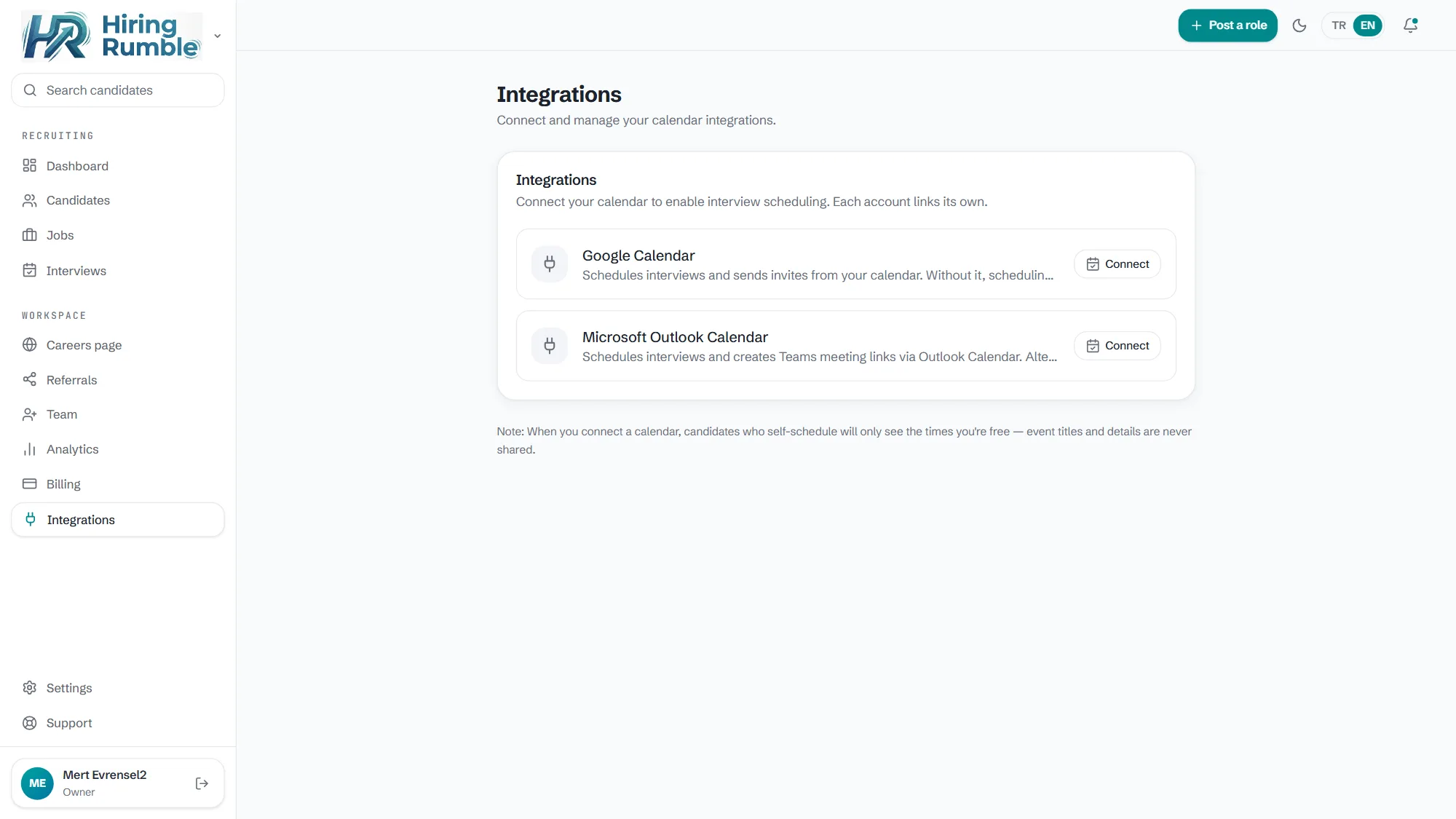
There's one thing as important as good questions: interviewing the right candidates. You want to spend your time meeting a shortlist that genuinely fits the role. This is where an AI-powered ATS saves time: Hiring Rumble reads incoming resumes against the role, gives a 0-100 fit score, and shows the reason for every score; so you walk into interviews with the strongest, reasoned candidates. With interview scheduling, you connect your calendar, share available times, and send invites automatically — the back-and-forth email traffic ends. AI screens and ranks; the interview and final decision are always yours.
Related reading: AI Resume Screening · Candidate Evaluation Criteria