Practical Ways to Reduce Bias in Hiring
How can you reduce bias in hiring? Practical steps for fairer decisions with structured criteria, transparency, and explainable AI.
Bias usually arises not from ill intent but from the mind's quick shortcuts: a familiar school, a similar background, an "one of us" feeling. But these shortcuts can keep you from seeing good candidates and make your decisions indefensible. Reducing bias in hiring becomes possible by adding structure and transparency to your process. This post covers how bias seeps into hiring, practical steps to reduce it, and the role explainable AI plays here — while preserving the "human keeps the decision" principle.
Where does bias seep into hiring?
- The posting stage: unnecessarily long "must have" lists that call for a specific profile discourage qualified candidates.
- The screening stage: evaluating each candidate by a different measure produces inconsistency and hidden bias.
- First impressions: fixating on a single detail (school, name, a gap period) and rejecting a candidate early.
- Black-box tools: an "AI score" that doesn't show its reason can make bias invisible — you can't correct what you can't see.
Practical steps to reduce bias
1. Define criteria in advance and in writing
Before screening, clarify required and preferred criteria. Evaluating everyone against the same list narrows the space for "gut feel."
2. Use structured evaluation
Score candidates on concrete dimensions like skills, experience, and fit. Structured evaluation moves the decision from personal sympathy to evidence.
3. Record the reasoning
Write down the reason for each decision. When reasoning is visible, you can spot and correct an illogical pattern (for example, always advancing similar profiles).
4. Standardize the first pass
Run the first-round screen with the same criteria for everyone. A consistent first pass sets the fairness of every later stage.
5. Choose transparent tools
No AI you use should hide the reason for its score. Transparency is the first condition for reducing bias.
How does explainable AI reduce bias?
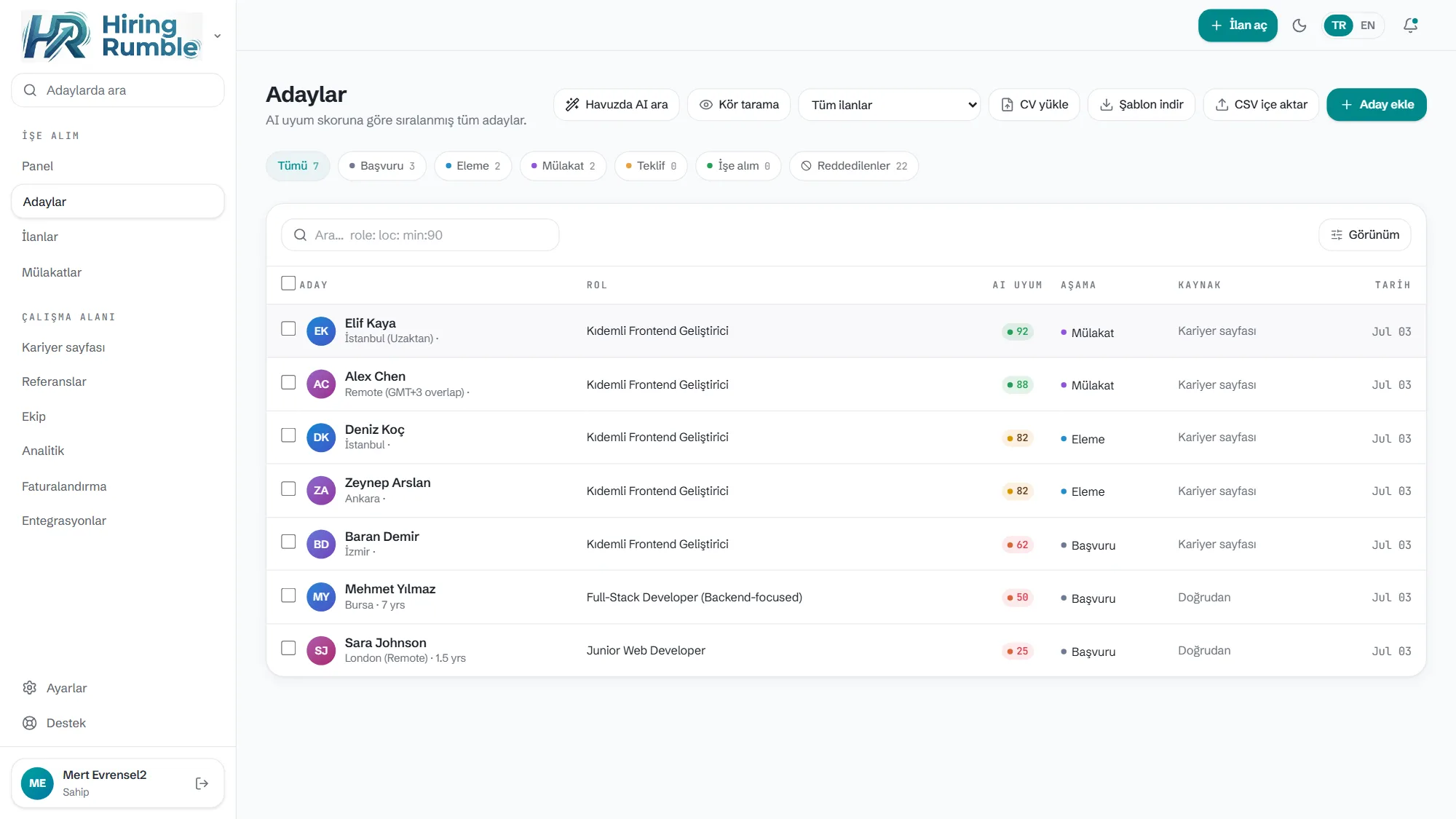
The critical distinction here: a black-box AI can hide bias, while an explainable AI makes it visible. Hiring Rumble reads each resume against the role, gives a 0-100 fit score, and shows the reason for every score across skills, experience, and fit. Thanks to this reasoning:
- You see why a candidate stands out — you look at evidence, not just a number.
- If there's an illogical pattern in the evaluation, you can spot and correct it.
- You can defend your decision within your team and ethically.
On top of that, a blind screening mode masks the candidate's name, photo, location and email during first review; you see only the skills and the score. Revealing the identity is written to the audit log — so "competence first, names later" isn't just an intention, it's a traceable flow.
And most important: AI auto-rejects no candidate; it screens, ranks, and gives reasoning. You always make the accept or reject. The way to reduce bias isn't to put AI in the human's place, but to make the human's decision more transparent and consistent.
Related reading: Explainable AI Hiring · AI Resume Screening