What Is an ATS? A Beginner's Guide to Applicant Tracking
What is an ATS, what does it do, and why do small teams need one? Learn the core functions of an applicant tracking system and what AI adds to it.
There's a common acronym you'll hear in the hiring world: ATS. So what is an ATS, and does a small team really need one? An ATS (Applicant Tracking System) is software that brings applications, candidates, and the whole hiring process into one place. Instead of scattered inboxes and spreadsheets, it keeps every posting and every candidate organized. This guide explains what an ATS is, its core functions, who needs one and when, and what AI adds to a modern ATS.
What does an ATS do?
An applicant tracking system brings order to hiring chaos. Its core functions:
1. Collects applications in one place
All applications from job boards, your careers page, and referrals come together in one system. No candidate gets lost in an inbox pile.
2. Parses resumes
PDF/DOCX resumes are turned automatically into structured data — skills, experience, education. Manual data entry disappears.
3. Breaks the process into stages
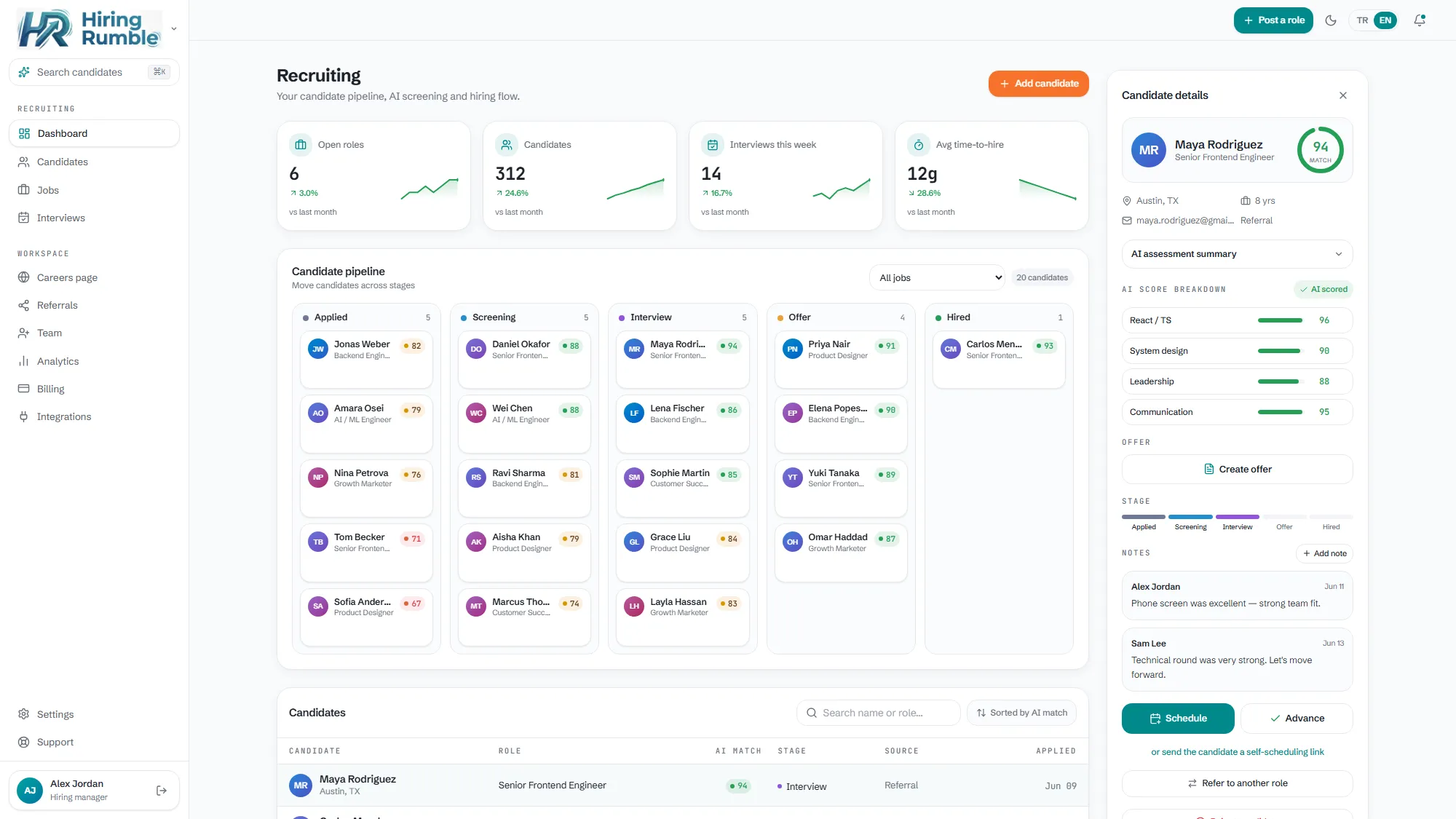
Candidates move through clear stages like Applied → Screening → Interview → Offer → Hired. Where each candidate stands is clear at a glance.
4. Enables team collaboration
With scorecards, notes, and roles, the team evaluates the same candidate consistently.
5. Measures the process
With metrics like time-to-hire, funnel conversion, and source quality, you see where you're losing.
Who needs an ATS, and when?
For a single position and a few applications, a spreadsheet works for a while. But an ATS becomes necessary when these signals appear:
- You're opening multiple postings at once.
- Application volume exceeds what you can track by hand.
- Other people are joining the team; you need shared evaluation.
- Tracking which stage candidates are in becomes hard.
What does AI add to a modern ATS?
A traditional ATS "stores and organizes." A modern, AI-powered ATS goes a step further: it helps you evaluate incoming resumes. Hiring Rumble reads each resume against the role, gives a 0-100 fit score, and shows the reason for every score across skills, experience, and fit. So the strongest candidates surface in seconds — but the decision always stays with you. AI screens and ranks; you make the accept or reject.
And a good modern ATS can fit a small-team budget: Hiring Rumble starts on a free plan, can be tried in keyless demo mode with nothing to set up, and the interface + candidate emails are bilingual (TR/EN).
Related reading: Best Applicant Tracking System · Applicant Tracking System for Small Business
Frequently Asked Questions
Is an ATS the same as a CRM? No. A CRM manages customer relationships; an ATS manages the hiring process — applications, candidates, and stages. Their purposes differ.
Does a small team need an ATS? For a single position and few applications, a spreadsheet may suffice. But with multiple postings, growing volume, or a growing team, an ATS gives back time and consistency.
Does an AI-powered ATS decide for me? No. AI screens, ranks, and gives reasoning; you make the accept or reject. That's exactly why explainability matters.